Tuesday, October 6, 2015

Finding Lines in Nature

Work by Mrs. Blundy's 2nd Graders who were finding lines in Hokusai's Great Wave
In the 2nd grade at Prescott, student artists learn about famous artists and their art.  This week, they learned about Japanese artist Hokusai.  In class, we looked at some of his waterfall pictures and his famous picture called Great Wave off Kanagawa.  The students learned that these pictures are not paintings.  They are prints!  We watched a quick demonstration that shows how a print is made, and we noticed that prints are usually full of lines the artist carved into a block to create a picture.  Then we had some fun using sumi-e materials including ink and bamboo brushes to find lines in Hokusai's work.  Students began with a teacher-led demonstration of how to use the brush to make skinny or fat lines.  They then painted lines on a copy of his picture before doing it on their own paper.  They really did a beautiful job!

Elyza, Grade 2

Jair, Grade 2

Aubry, Grade 2

Jefrey, TJ, Caleb and Matthew, Grade 2

Bella, Grade 2

Bella's finished work!

Alexis's finished work!

Friday, October 2, 2015

Showing our Colors

Grade 1 has been constructing 3-D paper chameleons inspired by Leo Lionni's illustrations.  A Color of his Own is a great story about a lonesome chameleon who finds a friend.  The students practiced making patterns, cutting tricky shapes, and following directions to make their 2-D drawings 3-D.

Caleb, Grade 1

Leyla, Grade 1

Kennedy, Grade 1

Allejandro, Grade 1

Natalia, Grade 1


Thursday, October 1, 2015

We're Going on an Architecture Tour!

Lily, Grade 6, Drafting a Template for the John Hancock Tower
        I was lucky enough to see the Hokusai exhibit at the Museum of Fine Arts in Boston this summer.  Besides his famous woodblock prints, like The Great Wave off Kanagawa, they were exhibiting some of his paper dioramas.  I thought they looked like something that would be a fun project for art class, and I thought about how it was a good way for students to practice thinking spatially.  They would have to plan in 2-D to build in 3-D.  When I read about it, I learned that this Japanese art, tatebanko, is having a resurgence in popularity because you can post templates online, print them out, and build models from the templates.  When Ms. Gow told me that the middle school would be going on an architecture tour of Chicago, I decided we could collaborate by having students make dioramas of famous Chicago buildings.  As a result, the middle schoolers are researching, drafting and building models of a variety of buildings from our skyline.  I let them look at some patterns from buildyourownchicago.com , but I challenged them to just get ideas from these patterns rather than using these printed templates.  Their buildings all look different, but they are so much more interesting to see than if they all used a pre-drawn template.  They built a tatebanko box, and are creating scenes they will place their buildings in.  Here are a few "architects" at work:


Tatebanko, The Japanese Art of Paper Dioramas, Hokusai

Melanie, Grade 6, The Chicago Theater

Xithaly, Grade 6, Harold Washington Library

Manuel, Grade 6, Aqua Tower and John Hancock

Rylee, Grade 6, Federal Center
 
Monica, Grade 6, Willis Tower and John Hancock
  

Rylee added a Calder Flamingo to his Federal Center scene.

Antonio, Grade 6, Constructing a Tatebanko Box
 

Friday, September 25, 2015

Printmaking like Posada

La Catrina, by Jose Posada
After learning about Frida Kahlo and Diego Rivera this week, the third graders looked at prints made by Diego's teacher and mentor, Jose Posada.  He was a cartoonist and artist who was famous for his etchings of calacas and calaveras, most often in political cartoons.  The students got to try out printmaking for the very first time, and I think they are hooked.  They seemed to have a great time rolling the ink and trying to see how to get the best print.  They used styrofoam and scratched their drawings with dull pencils.  They used colorful paper and ink to capture the bright colors of sugar skulls, a common treat for el Dia de los Muertos. 


Thursday, September 24, 2015

Mondrian Madness

Piet Mondrian's abstract paintings make a wonderful example for the use of lines, shapes and colors.  The kindergarten classes are learning about primary colors, types of lines, and basic shapes in art.  They looked at his paintings, and then used vertical and horizontal lines to create rectangles and squares on a large piece of drawing paper.  They painted a few of the shapes with primary colors.  We used washable finger paint since I am just beginning to introduce these younger artists to the art room routines.  When I asked them what the paintings remind them of, they said cities, buildings, video games, quilts, maps and playgrounds!
Oliver, Kindergarten

Dania, Kindergarten

Lexie is gluing the lines onto her painting.

Kyle is almost finished!

Great job, Greta!

Wednesday, September 23, 2015

Funny Little Fridas (and a few Diegos...)

The second and third graders are learning about Frida Kahlo and Diego Rivera. 

For third grade, this ties in with their Art of Chicago course as they learn about The National Museum of Mexican Art (located here in Chicago).  This wonderful museum is free every day, and it hosts many family and children's art programs.  Right now, they have an exhibit for the Day of the Dead that includes ofrendas made by various artists from Chicago and Mexico.  I hope some students go to the musuem to see the exhibit.  I really want to go to the workshop that teaches how to decorate sugar skulls! 

As for the second graders, their year will be focused on famous artists, so we started with Frida and Diego!  Both sets of mini ofrendas are nearly finished, and I will display some at Prescott.  Go to the museum for the exhibit if you can!

Alexis, Grade 2

Ermuun, Grade 3

Monday, September 14, 2015

Creative Color Wheels


Aubrey, Grade 2

 
The second graders are off to a great start this year.  We began the year reviewing color theory.  Students went over what they have already learned about primary and secondary colors, and they learned what intermediate colors are.  They used the primary colors to mix every color on the color wheel, and they painted rectangles with each color they created.  They were very excited to see what colors they could "invent".  After filling a page with 16 colors, they cut out a repeated shape.  They arranged the shapes in order of the spectrum to create their own version of a color wheel.  I love how they are all different, and the kids really had to think about into what order to put the various shades of colors.  Here are some artists at work and some sample projects!
How many colors can you make? 


Jair filling in her squares...
The Blue Table worked hard!

Some students traced shapes, others drew their own.
They arranged the shapes in order of the spectrum.
Jamie tracing and Alyssa gluing...


Arranging Rainbow "Donuts"

Jefrey, Grade 2

Darius, Grade 2

Jair, Grade 2


Alyssa, Grade 2


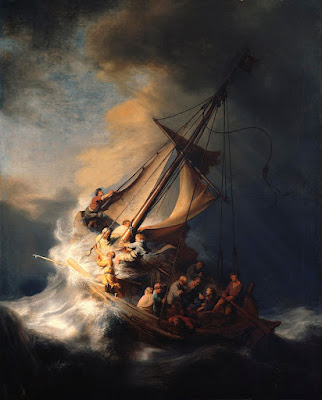
Stormy Seas Ahead

Rembrandt's Stolen Work, Christ in the Storm on the Sea of Galilee  My favorite new project this year was one I came up with when I was...